

As the renowned statistician George E.P. Box once remarked, “All models are wrong, but some are useful.” This perspective is especially relevant when considering the wide array of frameworks designed to explain leadership. No single model can fully capture the complexity and nuance of how leaders engage with and influence others. Still, these models can serve as valuable tools—offering structure, clarity, and insight as we strive to better understand leadership dynamics and refine our own approach.
In this article, we’ll explore two foundational frameworks behind the 3 leadership styles most professionals encounter: Kurt Lewin’s Three Leadership Styles and French and Raven’s Five Bases of Power. Lewin’s model focuses on the types of environments leaders create—ranging from directive to participative—while French and Raven’s framework outlines the sources of power leaders draw upon to influence and guide their teams.
Together, these models offer a two-dimensional lens for thinking about leadership: the style of organization you aim to build, and the means of influence you use to shape it. Understanding both dimensions can help leaders develop a more intentional, effective approach to leading others.
The Three Leadership Styles
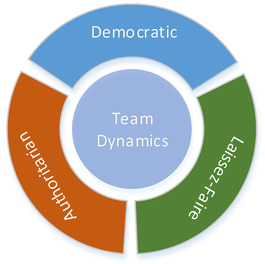
Authoritarian
– In an authoritarian environment, the leader makes all the decisions without consulting the team. The team often remains uninformed about future plans, with little to no input into the decision-making process. While the leader can be approachable and personable, this style doesn’t imply overt hostility—rather, it emphasizes top-down control and direction.Democratic
– A democratic leadership style encourages team participation and fosters collaborative discussions. Leaders who adopt this approach actively seek input from team members and present multiple options for future decisions. Team members are empowered to contribute to task allocation and decision-making. While research suggests that democratic teams may be less productive than those under authoritarian leadership, the work produced tends to be of higher quality due to greater innovation and team engagement.Laissez-Faire
– The laissez-faire model offers the most autonomy to team members, giving them complete freedom in decision-making. The leader provides necessary resources but typically refrains from active participation unless requested. This style works best with highly skilled teams that require minimal guidance. However, in less experienced or less cohesive groups, this style often leads to unclear roles and potential frustration within the team. It’s easy to assign value judgments to these leadership styles, often favoring one over another. Early in their careers, many leaders may mistakenly believe one style is inherently “better” than the others. However, the key to successful leadership lies in adaptability. The most effective leaders cultivate an awareness of their team’s needs and adjust their approach to fit the evolving dynamics of the organization.The Five Bases of Power
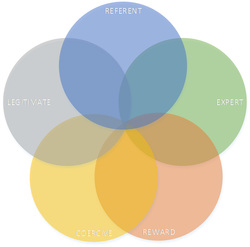 John French and Bertram Raven identified five distinct bases of power that leaders use to influence their teams. Understanding these sources of influence can help leaders strategically guide their teams and adapt their approach based on the situation at hand:
Coercive
– Coercive power is rooted in a leader’s ability to enforce compliance through the threat of punishment. While this form of power can be effective in ensuring short-term compliance—especially in critical situations where the organization’s survival is at stake—its overuse can lead to negative long-term effects, such as resentment and disengagement.Legitimate
– Legitimate power is derived from the formal position a leader holds within the organizational hierarchy. Team members comply because they believe the leader has the right to issue orders. While legitimate power can foster compliance, it doesn’t necessarily inspire commitment or cooperation. Its effectiveness depends on the stability and clarity of the authority structure within the organization.Reward
– Reward power stems from the leader’s ability to provide rewards, both tangible (e.g., bonuses, promotions) and intangible (e.g., recognition, praise). While reward power is generally viewed positively, an overreliance on it can shift the team’s focus from the work itself to the rewards. In extreme cases, this might lead to unethical behaviors as team members strive to meet targets for rewards.Referent
– Referent power is based on the respect and admiration that team members have for their leader. It is characterized by a leader’s ability to inspire others to identify with or emulate them. This type of power hinges on strong, trust-based relationships, and it is the most difficult to scale within an organization. A leader must continually cultivate and maintain this respect to sustain their influence.Expert
– Expert power arises from a leader’s specialized knowledge, skills, or expertise. Team members rely on the leader’s insight because they view them as an authority in a particular area. However, as the leader shares their expertise, their expert power diminishes, and over time, they may lose the authority that comes with it. If the leader withholds knowledge to maintain their expert power, the organization’s overall effectiveness may suffer. While it can be tempting to categorize each type of power as inherently good or bad, the reality is more nuanced. When applied thoughtfully and ethically, each base of power can be a valuable tool for influencing a team. An exceptional leader is one who can assess the needs of their organization and adapt their approach to best serve those needs, ensuring the long-term success and growth of both the team and the organization.Leadership Styles Questions, Answered
Clear answers to the most common questions about Lewin’s three leadership styles and the five bases of power.
What are the 3 leadership styles?
Kurt Lewin identified three core leadership styles: authoritarian (the leader makes decisions alone), democratic (the leader invites team input), and laissez-faire (the leader gives the team full autonomy). Each shapes a different kind of team environment.
Which of the 3 leadership styles is best?
No single style is best. Authoritarian leadership is fastest in a crisis, democratic leadership produces higher-quality and more engaged work, and laissez-faire suits highly skilled, self-directed teams. The strongest leaders adapt their style to the team and situation.
What is the difference between leadership styles and the bases of power?
Leadership styles (Lewin) describe the kind of environment a leader creates. The five bases of power (French and Raven) — coercive, legitimate, reward, referent, and expert — describe the sources of influence a leader uses within that environment.
Ready to discover your strengths?
Create a free account to take our assessments, save your Career Profile, and get matched with recruiters.
Create a Free Account